Start
Report what happened and share the essentials.
USAA · Claims Storefront
I reorganized the claims storefront around the questions members ask in stressful moments: where to begin, what they need, and what happens next.
Explore the challengeIndependent portfolio reconstruction based on publicly available experience patterns.
Claims journey
Report what happened and share the essentials.
See what happens next, what is needed, and why.
Complete the next task and stay informed.
Track progress through review and resolution.
The opportunity
A claims storefront has to do more than send people to the right page. It must help someone who may be overwhelmed recognize their situation, understand their options, and take the next step.
For this portfolio reconstruction, I examined how the public experience could move from a collection of insurance destinations to a guided path based on what members need to do.
The work focuses on content structure, findability, progressive disclosure, and the handoff from general claims support into specific tasks.
Challenge
The member moment
“I don’t need to understand insurance. I need to understand what to do right now.”
Claims begin in moments of disruption. The interface has to lower cognitive load before it can ask someone to make a choice.
Members may need to report damage, check an existing claim, get roadside help, or understand coverage.
Insurance terminology competes with the language people naturally use to describe what happened.
Urgency and uncertainty make dense navigation, duplicate choices, and unclear handoffs more costly.
Public experience inventory
Content groupings reconstructed from publicly available USAA claims pages and search descriptions.
Information architecture
Members interpret categories and page labels before they can identify the right next action.
Start with a recognizable goal, then progressively reveal the detail required to complete it.
The experience in context
The redesign reduced the burden of interpreting navigation, brought the two most important actions forward, and used recognizable situations to help members find relevant support.

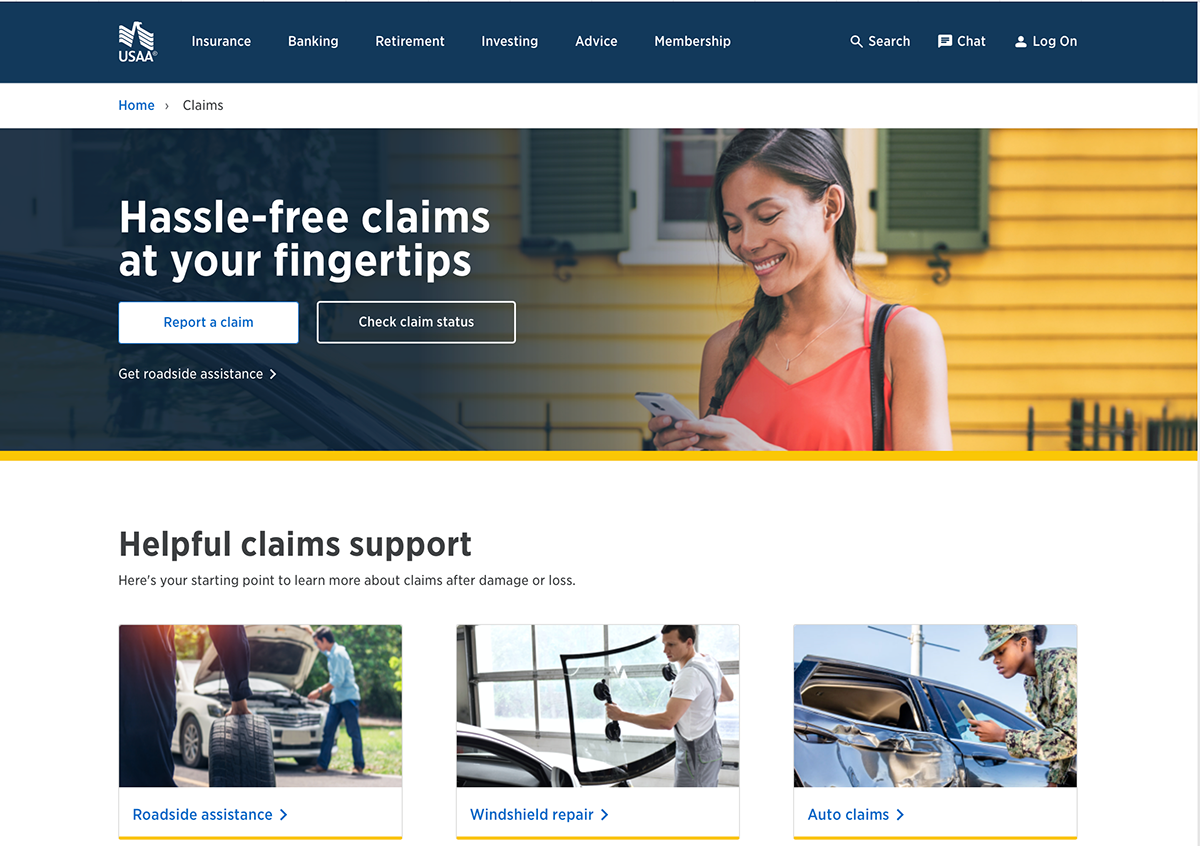
Every choice should answer one question and create one unmistakable next step.
Wireframe system
The sequence narrows the decision space gradually: orient first, clarify the event, then set expectations before the handoff.
Experience principles
Use the language of member goals before introducing claim categories or product terminology.
Explain what is needed, how long a task may take, and what will happen after submission.
Show progress, status, and ownership so members always know where they are and who acts next.
05 · Reflection
Starting with member intent creates a clearer bridge between a stressful real-world event and the insurance tasks required to resolve it. It also makes the experience easier to scan and easier to extend across claim types.
The next step would be to validate the model with members across new and existing claims, then measure task selection, handoff success, and avoidable support contacts.
What I would validate next